Location: New Delhi, India | Date: December 14, 2025 | Read Time: Around 4 minutes
Summary
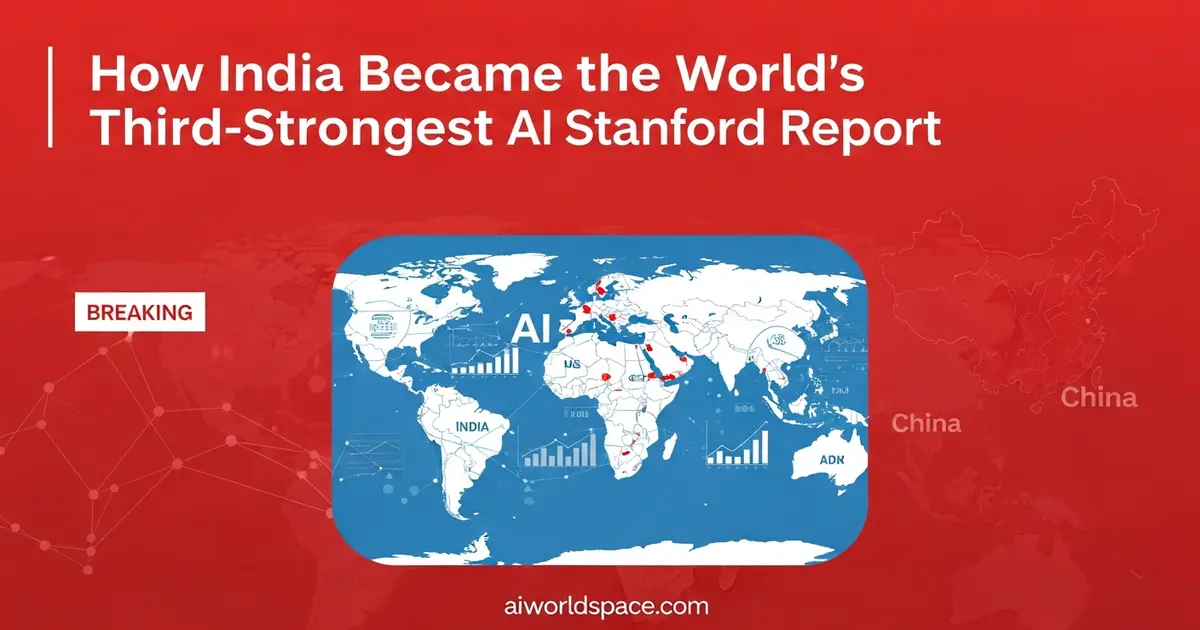
India has quietly climbed to third place in global AI competitiveness, according to Stanford University’s latest assessment. Backed by deep talent pools, rising research output, and steady investment, India now stands just behind the US and China, overtaking several advanced economies.
Why Stanford’s AI Rankings Signal a Turning Point for India
For years, India’s role in artificial intelligence was largely seen through the lens of talent supply. The latest findings from Stanford University’s Global AI assessment suggest that perception is changing fast. India now ranks third globally in AI competitiveness, a position that places it ahead of countries such as the UK, Germany, Japan, and South Korea.
Read In Hindi:- कैसे भारत चुपचाप दुनिया की तीसरी सबसे बड़ी AI ताकत बन गया
This rise has not come from a single breakthrough or policy announcement. Instead, it reflects a steady build-up of capability across talent, research, and real-world adoption of AI technologies.
Also Read:-Artificial Intelligence Could Make X-Rays Clearer and More Accurate
Talent at the Core of India’s AI Momentum
A key factor behind India’s rise is its expanding base of AI-skilled professionals. Each year, the country produces a large number of engineers, data scientists, and AI researchers, many of whom are working on complex projects both at home and across global technology firms.
This concentration of talent has made India an increasingly important hub for AI development. Global companies are setting up research centres, while Indian professionals are taking on leadership roles in critical AI systems, moving the country beyond a support role into one of innovation and execution.
Also Read- Rajasthan Police Starts AI Training to Tackle Deepfake and Voice-Cloning Crimes
Research Output Is Catching Up Fast
India’s growing influence is also visible in research. Contributions to AI-focused academic papers, patents, and open-source platforms have increased steadily. Universities, startups, and private labs are collaborating more closely, helping research move faster from theory to application.
Stanford’s analysis reflects this shift, showing India closing the gap with traditionally dominant research economies.
Investment and Startups Add Real-World Scale
Another important driver is capital. AI startups in India are attracting increased investment across sectors such as healthcare, finance, agriculture, and public services. Rather than remaining experimental, AI tools are being deployed at scale, addressing local challenges while building globally relevant solutions.
This practical adoption is strengthening India’s position as not just a producer of talent, but as a creator of AI-driven products and platforms.
The Bigger Shift
India’s move into the global top three signals a broader change in how AI leadership is distributed. The field is no longer dominated by a handful of Western economies. With its combination of talent depth, research momentum, and market scale, India is emerging as a central player in shaping how AI evolves and is applied.
If this trajectory continues, India’s influence on global AI standards, partnerships, and innovation priorities is likely to grow significantly in the years ahead.
Key References:
- Business Today: https://www.businesstoday.in/technology/news/story/global-ai-race-india-emerges-as-a-powerhouse-takes-third-spot-in-stanford-ranking-506572-2025-12-14
- NDTV: https://www.ndtv.com/world-news/india-ranks-3rd-in-ai-competitiveness-after-us-and-china-stanford-university-report-9806521
- The Economic Times: https://www.thehindubusinessline.com/info-tech/india-ranks-third-in-global-ai-index-after-us-china/article70395165.ece
- Visual Capitalist (source chart): https://www.visualcapitalist.com/cp/ai-competitiveness-by-country/