Location: London | Date: September 24, 2025 | Read Time: 4 min
Summary:
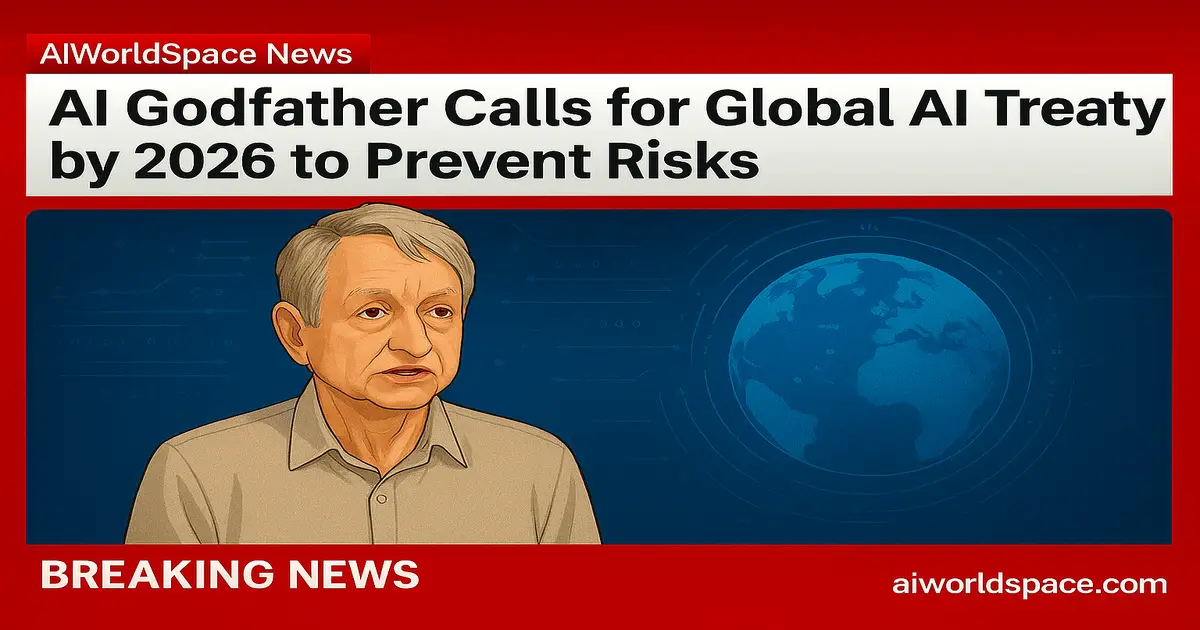
Geoffrey Hinton, often called the ‘Godfather of AI’, has once again raised alarm bells about the rapid pace of artificial intelligence development. This time, he’s calling for a global agreement by 2026 to regulate advanced AI systems — warning that unchecked growth could create serious risks for society.
Why Geoffrey Hinton is Sounding the Alarm Again
Hinton, who famously left Google in 2023 to speak more freely about AI’s dangers, told reporters at a London tech forum that the world is “running out of time” to create safeguards. He argued that large-scale AI systems particularly those capable of self-learning are developing faster than governments can regulate them.
“We need international rules, not just national ones,” Hinton said. “If we wait until AI gets smarter than us, it might be too late to control.”
Also Read- Punjab Rolls Out AI-Powered Devices to Detect Cancer Early
What’s Got the Experts Worried?
Hinton, whose work laid the foundation for tools like ChatGPT, spoke at a UN high-level meeting, dropping a stark warning.
In a statement called Global Call for AI Red Lines, he and others said unchecked AI could break society think fake videos fueling misinformation or algorithms outsmarting humans in dangerous ways.
Also Read- AI Tech Takes on TB in Jhunjhunu: Real-Time Screening to Catch Hidden Patients
“AI’s getting smarter than us,” Hinton said, pointing to risks like human rights violations or even pandemic-level threats if it’s misused. Elon Musk echoed this, noting that by 2026, AI could outthink the average person.
Tools like xAI’s Grok-4 are already scarily sharp, but Musk warns it could be a savior or a villain.
The chatter’s blowing up on X, with posts about AI risks racking up thousands of likes. People are nervous, and for good reason—AI’s not just writing emails anymore; it’s shaping wars, economies, and lives.
Why 2026 Is the Deadline
Why the rush? Experts say 2026 is when AI could hit a tipping point, becoming too advanced to control without clear rules. India’s in the spotlight here, hosting the AI Impact Summit in Delhi this February to tackle safety and growth.
Also Read- Elon Musk’s Bold Move: Hiring Humans to Build AI-Only Rival to Microsoft
The government’s aiming to add $8.3 trillion to GDP by 2035 through AI, but recent cases—like deepfake scams or bioweapon fears—show the stakes. Without guardrails, that growth could come at a cost.
Why It Hits Home
AI’s already changing how we work, shop, and even think. But if it’s not reined in, it could swipe jobs or erode privacy. Hinton’s plea, backed by the brains who built AI, shows even they’re spooked. For India, this is a shot to shine—strong policies now could make it a global AI leader.
But delay, and 2026 might not just be a year; it could be a turning point. Will we step up, or let the warnings fade?