NEW DELHI, JULY 11, 2025| Editorial
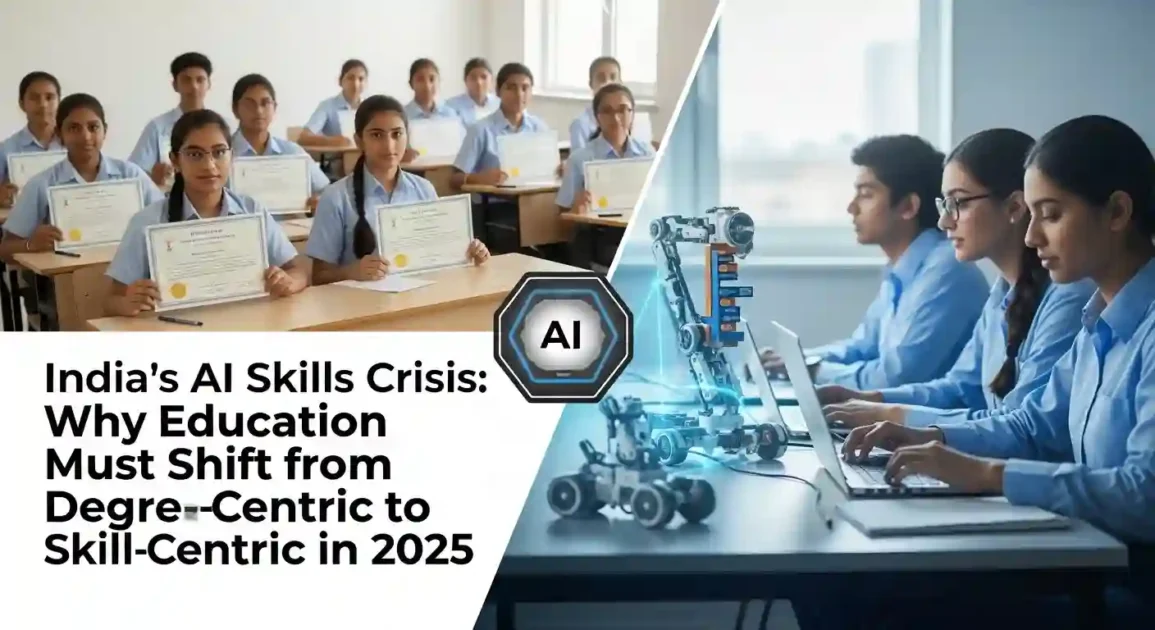
Why Degrees Alone Won’t Get You Hired Anymore
India is at a major turning point in 2025. A joint report by Google.org and the Asian Development Bank (ADB), released on July 7, 2025, has raised serious concerns on India’s AI Skills Crisis: if India fails to equip its workforce with AI-related skills, the country could fall behind in the fast-moving global race for jobs, innovation, and economic growth.
As artificial intelligence continues to reshape industries—ranging from healthcare and education to logistics and finance—employers are shifting away from hiring based solely on academic qualifications. Instead, they are prioritizing candidates who demonstrate real-world problem-solving, data literacy, and the ability to use AI tools like ChatGPT, AutoML, and data dashboards.
“Nearly 1.5 million engineering graduates pass out every year in India, but only 10% of them manage to get a job.”
— Times of India, 2024
This growing disconnect between formal education and employability is becoming more evident each year. A 2024 report by the Times of India found that only 10% of the 1.5 million engineering graduates in India were able to secure jobs aligned with their degrees. This statistic highlights a deeper issue: the traditional education system is failing to prepare students for the AI-driven economy.
Women and Rural Workers Could Be Left Behind
Beyond the general skill gap, certain groups are even more at risk—particularly women and rural populations. Today, women account for approximately 35% of India’s total workforce, yet a large number are employed in sectors like retail, clerical support, and customer service—roles that are rapidly being automated.
Rural areas present a similar challenge. Millions of people in villages and small towns still lack access to quality internet, computers, and basic digital literacy training. Without intervention, these populations may face increasing exclusion from the digital economy.
A 2024 study by NASSCOM and the Ministry of Skill Development revealed some sobering statistics:
| Group | Digital Skill Access (%) | Risk of Job Automation (%) |
|---|---|---|
| Urban Men | 68% | 24% |
| Urban Women | 42% | 39% |
| Rural Men | 31% | 47% |
| Rural Women | 18% | 53% |
These figures make it clear: rural women are the most digitally disadvantaged, and also face the highest automation risk. Bridging this gap is not just a social goal—it’s an economic necessity.
India’s AI Skills Crisis: What India Must Do to Prepare for the AI Era
The Google-ADB report outlines five essential steps India must act on urgently:
- First, India needs to launch job-oriented AI training programs at scale, accessible to students, job seekers, and professionals alike. These programs should include training in real-world AI tools such as TensorFlow, Midjourney, and chatbot platforms.
- Second, there must be a shift from theory to practice. Hands-on learning in key areas like machine learning, data analytics, and ethical AI deployment should become the core of these training initiatives.
- Third, AI awareness campaigns are needed across both urban and rural regions. Public education about AI’s impact on daily life and employment will help reduce fear, increase adoption, and create a tech-positive culture.
- Fourth, India’s MSME sector, which contributes over 30% to the country’s GDP, must be equipped with AI tools to increase efficiency and competitiveness. According to a 2025 report by the Indian Ministry of Commerce, only 7% of MSMEs are currently using AI-based systems.
- Fifth, digital equity must be ensured. This includes expanding access to internet infrastructure, affordable devices, and inclusive skilling programs, especially targeting women and marginalized communities.
A Chance for India to Lead, Not Just Catch Up
India stands at a defining moment. With over 900 million people under the age of 35, the country holds the world’s largest pool of untapped digital talent. The World Economic Forum estimates that 20 million AI-related jobs will be created in India by 2030. But who will fill these jobs?
If India embraces AI skill development now, it won’t just keep pace with the world—it could lead the next wave of global innovation. But if it continues to rely on outdated education models, it may miss this rare opportunity.
Education must evolve from being degree-centric to skill-centric. Job-readiness in the AI era will depend less on where you studied and more on what you can build, automate, or optimize.
What You Should Remember
AI is transforming the future of work at a rapid pace. For India to stay competitive and inclusive, it must urgently train its people in practical, AI-driven skills. This includes not just urban youth, but also women and rural workers who are at the highest risk of being left behind. With the right investment in upskilling, India can transform its demographic dividend into a digital superpower.
Also Read:
Top 10 AI Tools For Housewives to Instantly Simplify Your Daily Routine
Free AI Tools for Students Right Now: 10 Game-Changers for Smarter Studying
#ai,#ainewsupdate,#artifitialIntelligence,#Aiupdatesindia